
Protea Performance Center
Knee PRP & bone marrow concentrate in Tempe
Patients often come to Protea Performance Center in south Tempe with knee pain that keeps returning, a tendon or ligament injury that hasn't settled, or a knee that limits walking and exercise even after physical therapy, medication or injections. Dr. Danny Clark starts with a detailed evaluation and diagnostic ultrasound, then discusses whether PRP or bone marrow concentrate may be appropriate for you.
The discovery call is free, takes about 15 minutes, and comes with no obligation.
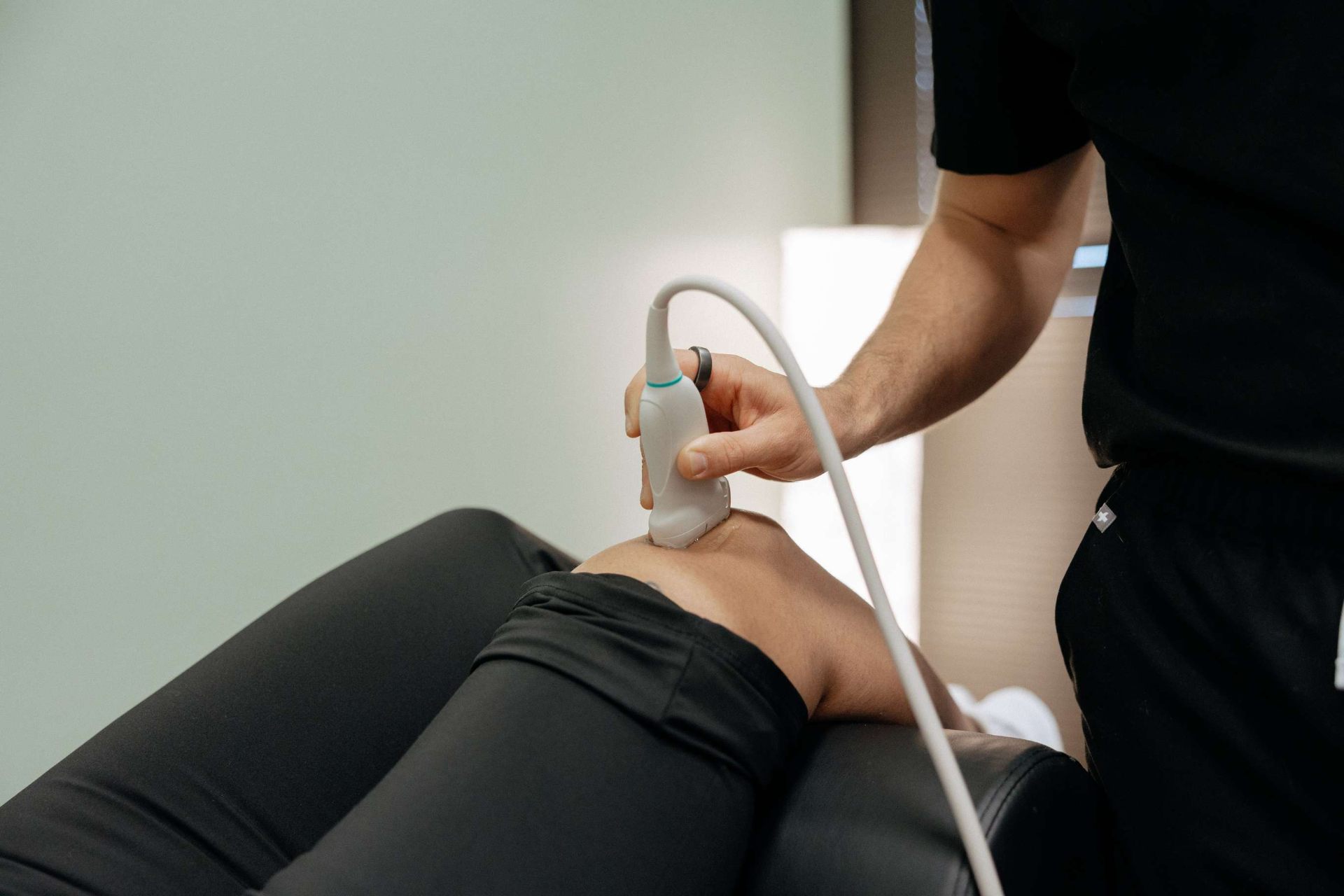
Knee arthritis
Can PRP help knee arthritis?
For some people with knee osteoarthritis, PRP can be an option worth discussing. The goal is to support the body's own repair processes and reduce pain, but results vary and the treatment does not help everyone.
An X-ray that shows arthritis doesn't always mean arthritis is the main source of the pain. Many people have arthritis on imaging without much discomfort, while the problem lies in a ligament, a tendon, the meniscus or an irritated nerve. In one of his videos, Dr. Clark explains that an inaccurate diagnosis is a common reason PRP or stem cell treatments don't work as hoped, which is why he examines each structure in the knee before recommending anything.
In one case he describes, a patient's evaluation found three separate sources of pain: an MCL sprain, meniscus degeneration and irritation of the infrapatellar nerve. All three were addressed in a single PRP procedure. Every knee is different and one patient's experience does not predict yours, but the case shows why the exam comes first.
Knee conditions we evaluate
- Knee osteoarthritis
- Meniscus tears and degeneration
- MCL injuries
- Patellar tendinopathy
- Cartilage defects and degeneration
Moderate to severe arthritis
What is subchondral PRP for knee osteoarthritis?
A subchondral injection places PRP or bone marrow concentrate into the bone just beneath the cartilage, in addition to an injection into the joint itself. Dr. Clark may consider this approach for moderate to severe knee osteoarthritis, which can be especially challenging to treat.
The subchondral bone is the foundation the cartilage sits on, and it contains blood vessels and bone marrow. In arthritis, this layer can also be inflamed and changed. The rationale for subchondral injection is to treat the bone beneath the cartilage as well as the joint space. It is a newer technique, the research is still developing, and Dr. Clark will discuss whether it is reasonable for your knee.
- Subchondral bone
- The layer of bone directly beneath the cartilage of a joint.
Choosing a biologic
PRP or bone marrow concentrate: which is right for my knee?
PRP is usually the first option considered. Dr. Clark may suggest bone marrow concentrate for more advanced degeneration or when PRP alone may not be enough, and he makes that recommendation only after the exam and ultrasound.
| Feature | PRP | Bone marrow concentrate |
|---|---|---|
| Comes from | Your blood | Your bone marrow |
| What it contains | Concentrated platelets from your own blood | Your own cells, including stem cells, combined with PRP |
| Often considered for | Usually the first option considered for tendon, ligament, meniscus and arthritis pain | More advanced degeneration, or cases where PRP alone may not be enough |
| How it is checked | Platelet count measured on an in-clinic hematology analyzer | Processed and concentrated in-office |
| How it is delivered | Ultrasound-guided injection | Ultrasound-guided injection, combined with PRP |
Ultrasound guidance helps Dr. Clark place each injection accurately, and the platelet count tells him what the preparation contains. Neither one guarantees a result. Research on PRP and BMC is still developing, the evidence is stronger for some conditions than others, and Dr. Clark will talk through what is known for your knee.
For arthritic joints, Dr. Clark may also use A2M (alpha-2 macroglobulin), a protein concentrated from your own blood that has anti-inflammatory properties, alone or with PRP or BMC. More on bone marrow concentrate.
Your first visit
What happens at the first knee visit?
Your first visit lasts up to 90 minutes, and you spend it with Dr. Clark. He performs the evaluation and the imaging himself, and if you go ahead with treatment, he performs the procedure too.
Detailed history
Dr. Clark starts with what you've already tried, what helped, what didn't, and which activities the knee now limits.
Pain-reproducing exam
He examines the joint, meniscus, ligaments, tendons and nerves around the knee, trying to reproduce the pain you feel day to day so he can tell which structures are involved.
Diagnostic ultrasound
In-office ultrasound shows the soft tissue in real time. You can watch the screen while Dr. Clark explains what he sees and how it fits with your history and exam.
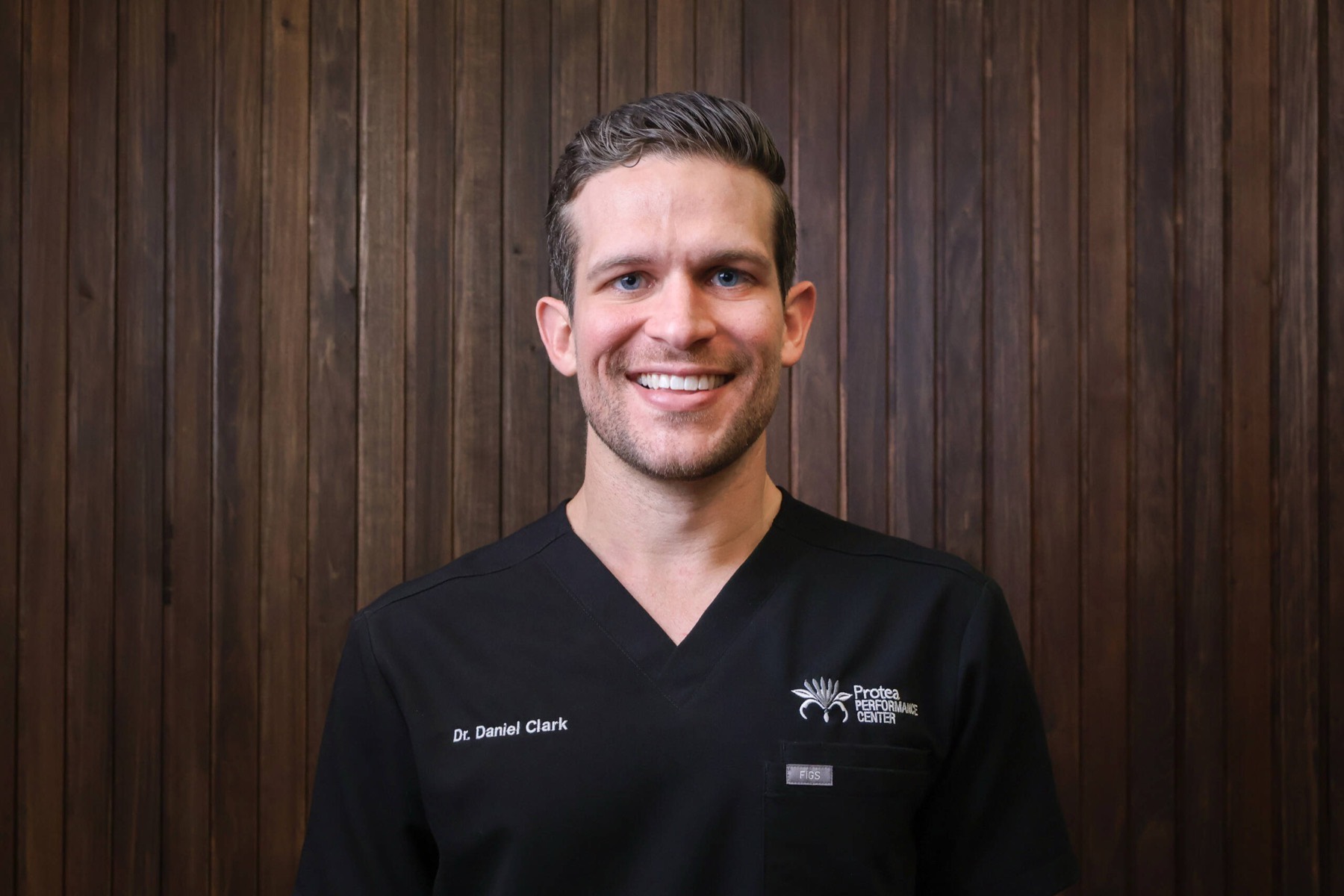
Dr. Danny Clark performs every procedure
Dr. Clark is a licensed Naturopathic Doctor and Director of Orthobiologics at Protea. He graduated with honors from Sonoran University of Health Sciences, completed a two-year residency in regenerative medicine, and studied kinesiology at Laurentian University. Every injection he performs is guided by ultrasound.
Recovery
How long until I notice a difference?
Response varies with the condition, the tissue involved and the person, so there is no set timeline. Every procedure includes a full re-evaluation at three months, with an exam and ultrasound, to review how the knee has responded.
You'll leave with recovery instructions tailored to your treatment, and the team coordinates with your physical therapist on when to begin gradual loading. Procedures are done one at a time, and you and Dr. Clark decide together whether anything more is needed. He describes the whole process, including when patients often begin to notice a change, in The Complete Orthobiologics Patient Experience.
Keep exploring
Other conditions Dr. Clark evaluates
Videos and articles on joint pain and regenerative care · New patient information
Prefer we call you?
Talk to us about your knee
The simplest first step is a free 15-minute discovery call. If you'd rather we reach out first, leave your details and a care coordinator will call you.
- First visit up to 90 minutes, with diagnostic ultrasound
- Platelet count measured before every PRP injection
- 3-month re-evaluation included with every procedure
This content is for education and is not medical advice. It does not replace an evaluation with a licensed provider, and no one should start, stop or change a medication on its basis.
Questions
Questions about knee PRP and bone marrow concentrate
Can PRP help knee arthritis?
For some people it can be an option. Knee osteoarthritis is one of the most common conditions Dr. Danny Clark evaluates. PRP is a concentrate of your own platelets, injected under ultrasound guidance with the goal of supporting the body's repair processes and reducing pain. Research results vary, and whether it is reasonable for your knee depends on what the exam and ultrasound show.
Is bone marrow concentrate the same as stem cell therapy?
When people look for stem cell therapy for the knee, what Protea offers is bone marrow concentrate (BMC), which contains your own cells, including stem cells. It is collected from you, concentrated in-office and combined with PRP. Dr. Clark will explain what is and is not known about BMC for your condition before you decide.
What is a subchondral injection?
A subchondral injection places PRP or bone marrow concentrate into the bone just beneath the cartilage, alongside an injection into the joint. Dr. Clark may consider it for moderate to severe knee osteoarthritis, with the aim of treating the bone under the cartilage as well as the joint space. Research on this approach is still developing.
Can PRP help a meniscus tear or MCL injury?
Meniscus tears and MCL injuries are among the knee conditions Dr. Clark evaluates. Whether PRP is a reasonable option depends on what the exam and ultrasound show, including whether other structures are also contributing to the pain.
Why do you measure the platelet count in my PRP?
Platelet concentration varies from person to person and from one preparation to the next. An in-clinic hematology analyzer measures the count before every PRP injection, so Dr. Clark knows what the preparation contains. It is a quality check on the preparation, not a guarantee of how your knee will respond.
How much do PRP injections for the knee cost?
There is no single flat rate. Pricing depends on the biologic used and the complexity of the procedure, and the team can go over current pricing on your free discovery call.
How do I get started?
Book a free 15-minute discovery call. There is no obligation. It is a chance to describe your knee, ask questions and decide whether a full evaluation makes sense.
Start with a conversation
Schedule a free discovery call about your knee
The call takes 15 minutes and there is no obligation. Tell us what's going on with your knee, ask your questions, and we'll help you decide whether a full evaluation with Dr. Clark makes sense.