Protea Performance Center

Regenerative Medicine & PRP Treatments in Tempe

Protea Performance Center offers specialized evaluations and orthobiologic treatment options for select joint, tendon, and musculoskeletal conditions. Led by Dr. Danny Clark, our approach combines detailed clinical assessments, diagnostic ultrasound, and image-guided procedures to help patients understand whether treatments such as PRP or bone marrow concentrate may be appropriate for them.

Schedule a Discovery Call (opens in a new tab)Explore Treatment Options

The discovery call is free, takes about 15 minutes, and comes with no obligation. Prefer a call back?

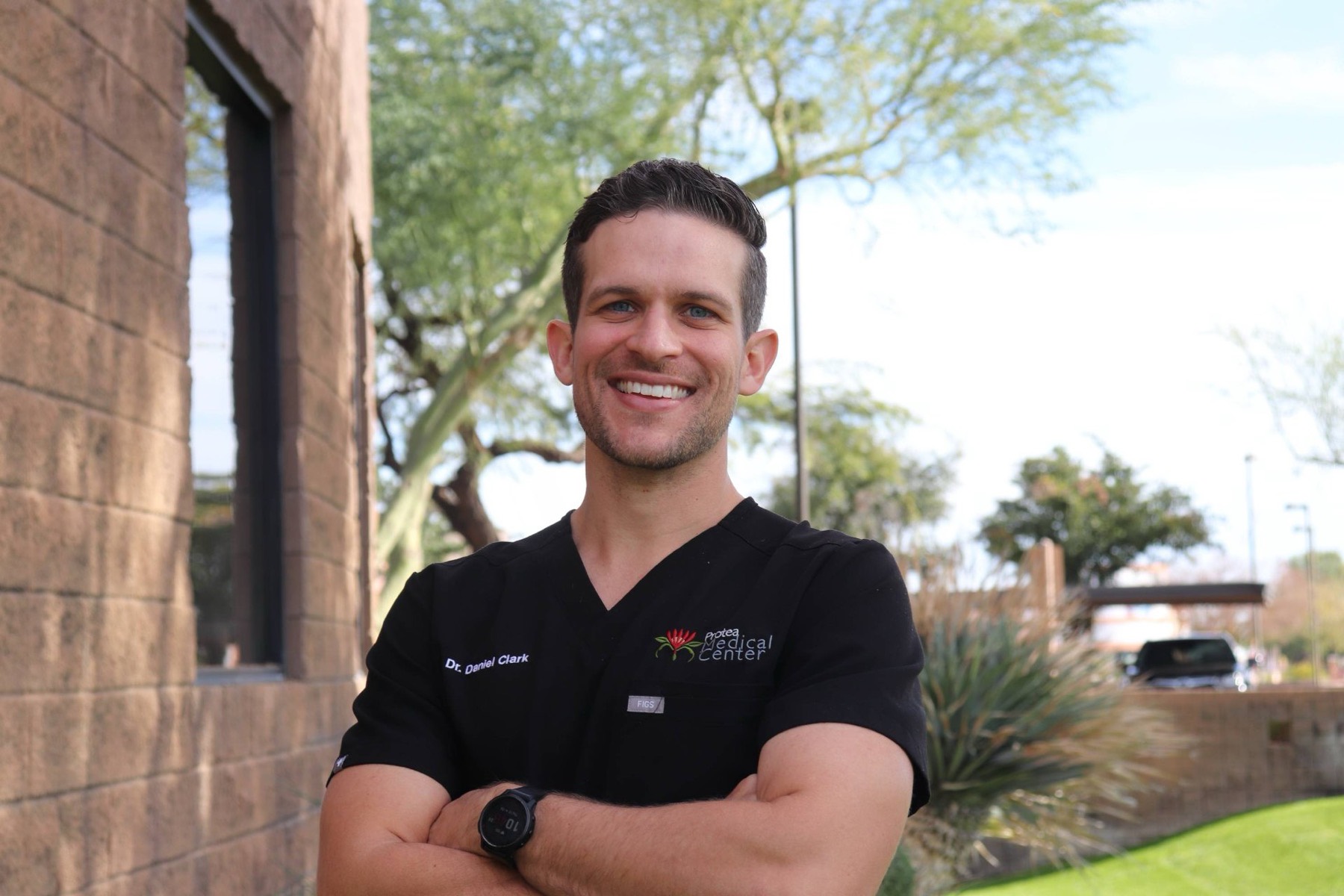
Dr. Clark performing an ultrasound-guided regenerative medicine procedure

Where care begins

Exploring your options for joint and musculoskeletal pain.

Persistent knee, shoulder, back, or joint pain can interfere with the activities you enjoy. When physical therapy, medication, or other conservative treatments haven't provided sufficient relief, you may be looking for additional options.

At Protea Performance Center, we begin with a detailed evaluation to better understand your symptoms, medical history, and previous treatments.

Dr. Danny Clark, Director of Orthobiologics, uses clinical examination and diagnostic imaging, when appropriate, to assess your condition and discuss available treatment options, including whether orthobiologic procedures may be suitable. Orthobiologics are injections prepared from your own blood or bone marrow, such as PRP and bone marrow concentrate, and Dr. Clark performs every procedure personally.

Patients often come to us with:

  • Knee pain that keeps coming back or limits your activity
  • Tendon injuries, such as rotator cuff, tennis elbow or Achilles problems
  • Stiffness or reduced mobility in a joint or your back
  • Previous treatments that haven't provided enough relief
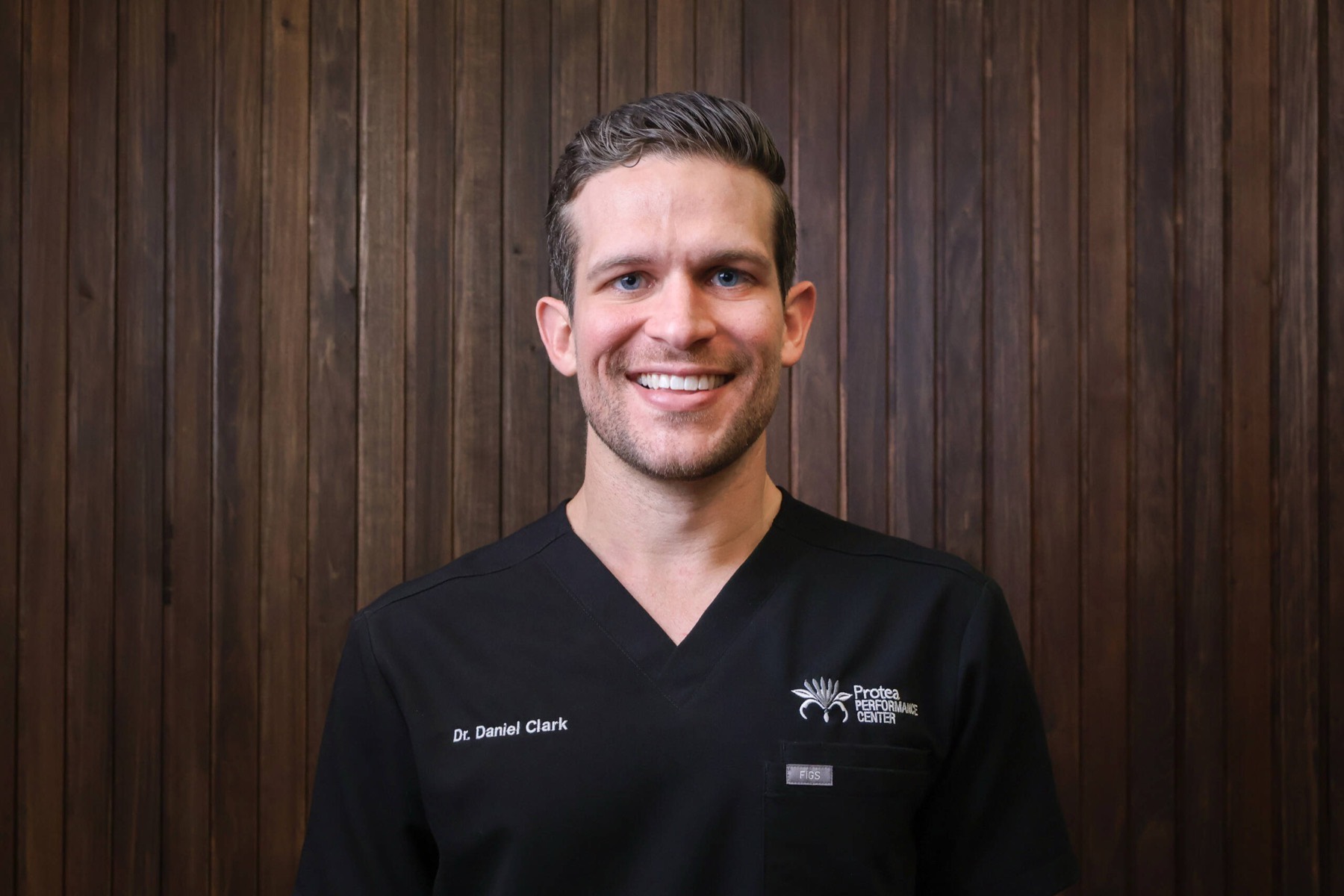
Dr. Danny Clark, Director of Orthobiologics at Protea Performance Center

Watch

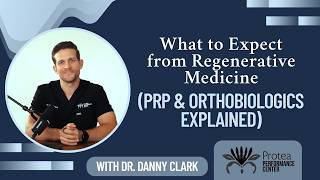
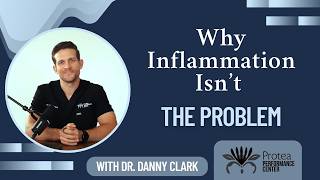
Video: Dr. Clark on orthobiologic care

Dr. Clark explains how he evaluates chronic pain and how orthobiologic procedures are performed at Protea.

Your first visit

What happens at your first visit?

Your first visit can last up to 90 minutes. Before recommending any treatment, Dr. Clark wants a clear picture of what may be contributing to your pain.

Detailed history

We start with your history: what you've tried, what helped, what didn't, and how the pain affects your daily life. This conversation guides the rest of the evaluation.

Physical exam

During the exam, Dr. Clark tests the joint, tendons, ligaments, muscles and nerves and tries to reproduce the pain you feel. Finding which movements and structures provoke it helps identify what may be contributing to your symptoms.

Diagnostic ultrasound

In-office ultrasound shows your tissue in real time, and you can watch the screen with us. Dr. Clark walks you through what he is seeing, including any areas of damage and the surrounding structures.

What we treat

Which conditions does Dr. Clark evaluate?

Dr. Clark sees patients with a wide range of orthopedic and nerve conditions. A condition appearing on this list does not mean a procedure is right for you; treatment is recommended only after an evaluation.

Knee

  • Knee osteoarthritis
  • Meniscus tears
  • MCL injuries
  • Patellar tendinopathy
  • Cartilage defects and degeneration

Shoulder

  • Rotator cuff tears (partial and full-thickness)
  • AC joint dysfunction and arthritis
  • Labral tears
  • Supraspinatus tendinopathy

Hip

  • Hip osteoarthritis
  • Labral tears
  • Gluteal tendinopathy
  • Trochanteric bursitis
  • Hip impingement

Back & Spine

  • Facet joint dysfunction
  • Disc-related pain and degenerative disc disease
  • SI joint dysfunction (including postpartum)
  • Lumbar and iliolumbar ligament laxity
  • Multifidi atrophy
  • Spinal ligament instability

Elbow

  • Tennis elbow (lateral epicondylitis)
  • Golfer's elbow (medial epicondylitis)
  • Elbow tendinosis

Hand & Wrist

  • CMC joint arthritis (thumb base)
  • De Quervain's tenosynovitis
  • Wrist tendonitis and ligament sprains
  • Hand and wrist arthritis

Foot & Ankle

  • Plantar fasciitis and fasciosis
  • Achilles tendinopathy (insertional and midportion)
  • Ankle arthritis and cartilage degeneration
  • Chronic ankle sprains and ligament laxity

Nerve Conditions

  • Carpal tunnel syndrome
  • Cubital tunnel syndrome
  • Peripheral nerve entrapment
  • Scar tissue and post-surgical adhesions
  • PTSD, generalized anxiety, chronic insomnia (via stellate ganglion block)

Treatments

Treatment options at Protea Performance Center

Dr. Clark offers several image-guided procedures. Which one he recommends, if any, depends on your evaluation and your goals.

Most Common

PRP Therapy (Platelet-Rich Plasma)

PRP is prepared from a sample of your own blood and concentrated to raise the number of platelets, which carry growth factors involved in the body's normal repair response. It is injected under ultrasound guidance into the area being treated. Before every PRP injection we measure the platelet count with an in-clinic hematology analyzer, so you know what the preparation contains. Research on PRP is stronger for some conditions than others, and Dr. Clark will discuss whether it is a reasonable option for yours.

Advanced

Bone Marrow Concentrate (BMC)

Bone marrow concentrate is prepared from a small sample of your own bone marrow and contains your own cells, including stem cells. Dr. Clark may discuss it for more advanced degeneration, or when PRP alone may not be enough. At Protea it is combined with PRP and delivered under ultrasound guidance. The evidence for BMC is still developing, and Dr. Clark will explain what is and isn't known before you decide.

Nerve Care

Nerve Hydrodissection

Not all pain comes from joints. When a nerve is entrapped, meaning compressed or stuck in surrounding tissue, it can cause pain, numbness and tingling. Nerve hydrodissection uses an ultrasound-guided injection of fluid to separate the nerve from the tissue around it, and the injection may include growth factors intended to support nerve recovery.

Nervous System

Stellate Ganglion Block (SGB)

A stellate ganglion block is an injection near a group of nerves in the neck that are part of the sympathetic, or fight-or-flight, nervous system. It is used for some patients with PTSD, generalized anxiety or chronic insomnia, with the aim of temporarily calming an overactive stress response. Dr. Clark performs it at two levels, on both sides of the neck. Whether it is appropriate depends on your history and an evaluation.

Anti-Inflammatory

A2M Therapy (Alpha-2 Macroglobulin)

Alpha-2 macroglobulin (A2M) is a protein that occurs naturally in your blood and has anti-inflammatory properties. We isolate and concentrate A2M from your blood and inject it under ultrasound guidance. It can be combined with PRP or bone marrow concentrate.

How Dr. Clark practices

How care works at the Performance Center

Diagnosis before treatment

The evaluation is designed to identify which structures are contributing to your pain, not only the most obvious one. Any treatment recommendation follows from that diagnosis.

Measured preparations

PRP is tested for platelet count with an in-clinic hematology analyzer, and bone marrow concentrate is processed in-office. Measuring a preparation documents what is being injected; it does not by itself guarantee a result.

Clear explanations

Dr. Clark shows you the ultrasound images and explains your diagnosis, your options and his reasoning, so you can make an informed decision about whether to proceed.

Ultrasound

How is ultrasound used at the Performance Center?

Dr. Clark uses ultrasound in two ways: to examine the tissue during your evaluation, and to guide the needle during every procedure.

Diagnostic

During your evaluation, in-office musculoskeletal ultrasound lets us look at the tendons, ligaments, cartilage and nerves in the painful area. You can watch the screen with us in real time.

Procedural

During every injection, real-time ultrasound guides the needle to the intended structure, whether that is a partially torn tendon, an arthritic joint or an entrapped nerve. Image guidance helps place the injection accurately. It does not by itself guarantee that a treatment will work.

At a glance

What to expect at Protea Performance Center

How evaluation and treatment work at Protea Performance Center
Part of your careAt Protea Performance Center
First visitUp to 90 minutes, including a physical exam and diagnostic ultrasound
Injection guidanceEvery injection is guided by real-time ultrasound
Pace of treatmentOne procedure at a time, with a re-evaluation before deciding on more
PRP preparationPlatelet count measured with an in-clinic hematology analyzer
ImagingDiagnostic ultrasound in the office during your evaluation
Who you seeDr. Clark performs the evaluation, the imaging and the injection

After treatment

What happens after a procedure?

Follow-up is part of every treatment, from recovery instructions to an included re-evaluation at three months.

  1. Recovery guidance

    After every procedure you receive recovery instructions for your specific treatment and anatomy, including what to expect, what to avoid, and when to begin gradual loading.

  2. Physical therapy coordination

    If you are working with a physical therapist, we coordinate with them so your rehabilitation plan fits the procedure you had. How the area is loaded during recovery is an important part of the plan.

  3. 3-month re-evaluation (included)

    About three months after treatment, you come back for a re-evaluation with a physical exam, ultrasound imaging and a review of how you are doing. This visit is included with every procedure.

  4. One procedure at a time

    We do not sell injection packages. After each treatment, we look at how you have responded and decide together whether further treatment makes sense.

Prefer we call you?

Not ready to book? Ask us to call.

Most patients start with the free 15-minute discovery call. If you would rather have someone reach out first, leave your details and a care coordinator will call you.

  • Free 15-minute discovery call
  • First visit up to 90 minutes, with diagnostic ultrasound
  • Dr. Clark performs the evaluation, the imaging and the injection

Request a call back

A care coordinator replies within one business day. Please don't include medical records here.

Questions

Questions about orthobiologics

What are orthobiologics?

Orthobiologics are injections prepared from your own blood or bone marrow, such as platelet-rich plasma (PRP) and bone marrow concentrate (BMC). At Protea they are placed under ultrasound guidance into the area being treated. Patients often explore them when physical therapy, medication or other conservative care has not provided enough relief. How well they work varies by condition and by patient.

How long is the first visit at the Performance Center?

Up to 90 minutes. Before recommending any treatment, Dr. Clark takes a detailed history, performs a physical exam, and examines the tissue with in-office diagnostic ultrasound to understand what may be causing your pain.

Is every injection ultrasound-guided?

Yes. Every injection is guided by real-time ultrasound so the needle can be placed in the intended structure. Image guidance improves accuracy; it does not by itself guarantee that a treatment will work.

Why do you measure the platelet count in PRP?

PRP preparations can vary in how many platelets they contain. We measure the platelet count with an in-clinic hematology analyzer before every PRP injection, so you and Dr. Clark know what is being injected.

Do I have to buy a package of injections?

No. We perform one procedure at a time, evaluate how your body responds, and then decide together whether further treatment is warranted. A 3-month re-evaluation with exam and ultrasound is included with every procedure.

Who performs the procedures?

Dr. Danny Clark, Director of Orthobiologics, oversees every evaluation and performs every procedure personally: the evaluation, the imaging and the injection.

How do I get started?

Schedule a free 15-minute discovery call. There is no obligation. It is a conversation about your pain and whether an evaluation makes sense. We see patients from across the Phoenix metro, including Scottsdale, Mesa, Chandler and Gilbert.

This content is for education and is not medical advice. It does not replace an evaluation with a licensed provider, and no one should start, stop or change a medication on its basis.

Start with a conversation

Talk with us about your joint or back pain

If you have been living with pain and are looking for other options, a free discovery call is a simple way to ask questions and find out whether an evaluation with Dr. Clark makes sense for you.

(480) 557-9095 · performancecenter@protealife.com
Tempe, AZ. We see patients from across the Phoenix metro, including Scottsdale, Mesa, Chandler and Gilbert.